Grid Connection Guard incl. CBC
In brief
The Grid Connection Guard incl. CBC extends the Grid Connection Guard with additional functionalities that align with the requirements for, for example, a capacity-limiting or flexible contract (CBC). In this form, agreements have been made between the grid operator and the connected party, whereby — in exchange for compensation — transport capacity is reduced at certain moments to help alleviate the effects of grid congestion. In practice, this means that through this regulation the contracted capacities can be adjusted on a scheduled or on-demand basis.
How it works
Typically, fixed contracted capacities apply to a grid connection as established in the general transport agreement (ATO). However, when a flexible contract is in place, these values will change depending on various signals. In broad terms, this will occur at fixed moments or be scheduled on demand.
Ramp-up / Ramp-down
Once a new restriction takes effect, it applies immediately. The connected assets often need time to move to the new setpoints, so a ramp-up and ramp-down is in place. Without this, the contract is likely exceeded straight away. The ramp-up or ramp-down lasts 2 minutes by default and can be adjusted.
The following example uses a contract of 100kW. A restriction of 90kW applies between 12:00 and 12:15, and a restriction of 80kW applies between 12:15 and 12:30. The ramp-up and ramp-down then run as follows.
- 11:58: ramp-down from 100kW to 90kW
- 12:13: ramp-down from 90kW to 80kW
- 12:30: ramp-up from 80kW to 100kW
Fixed moments
In the case of fixed moments, this can be configured so that it is handled automatically and locally. Once configured, no further action is required to ensure that the assets remain within the established limits of the grid connection.
Suppose a flexible contract has been concluded whereby the transport capacity for feed-in is limited to 0 kW between 12:00–16:00. Outside these times (from 16:00 to 12:00), a maximum feed-in capacity of 150 kW applies. The contracted capacity is set to 150 kW and a schedule is configured so that this changes to 0 kW between 12:00–16:00, ensuring that the connected assets automatically remain within these limits.
On demand (via API)
It is also possible to adjust the transport capacity limit via the API integration using a setpoint. Because these actions are also scheduled in advance, a timestamp for the start and end must be included. In the request, a limit for the consumption capacity and for the feed-in capacity can be submitted.
Visualisation
Below, two situations are shown that visualise the operation of the Grid Connection Guard incl. CBC. In both cases, this may concern a fixed scheduled moment or an action sent (once) via the API.
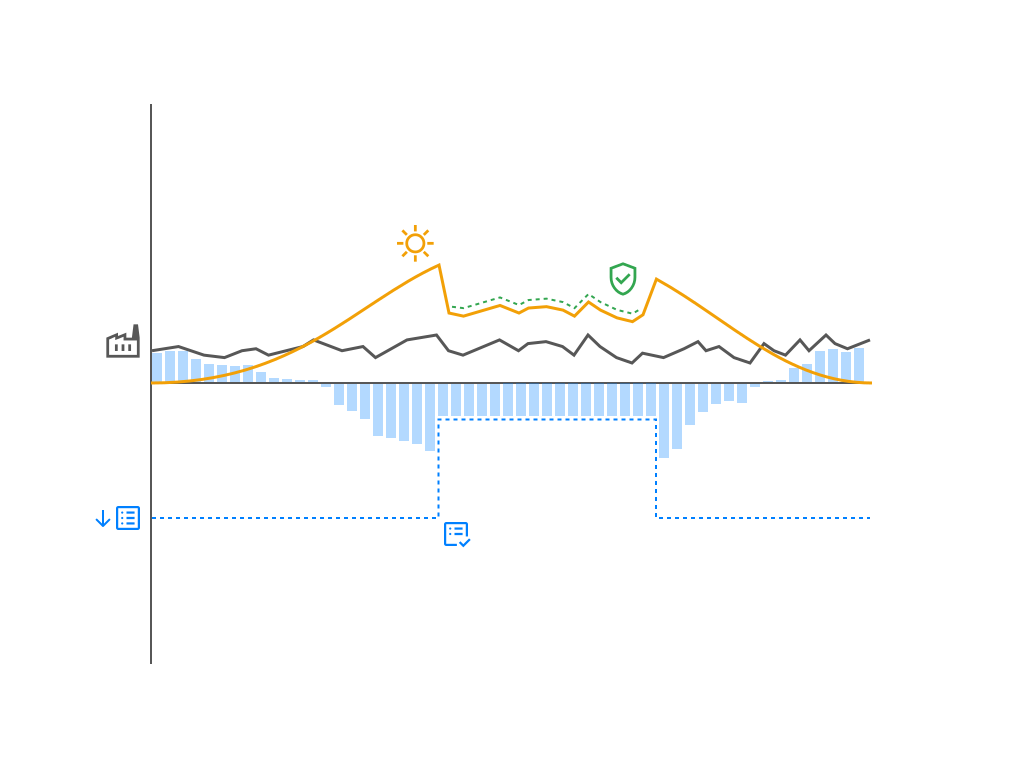
In the first graph, an example is shown where a restriction on the (export) transport capacity applies during the day. The PV system is curtailed as soon as the new export capacity restriction takes effect. The PV system is continuously adjusted to maximise generation without exceeding the transport capacity in effect at that moment.
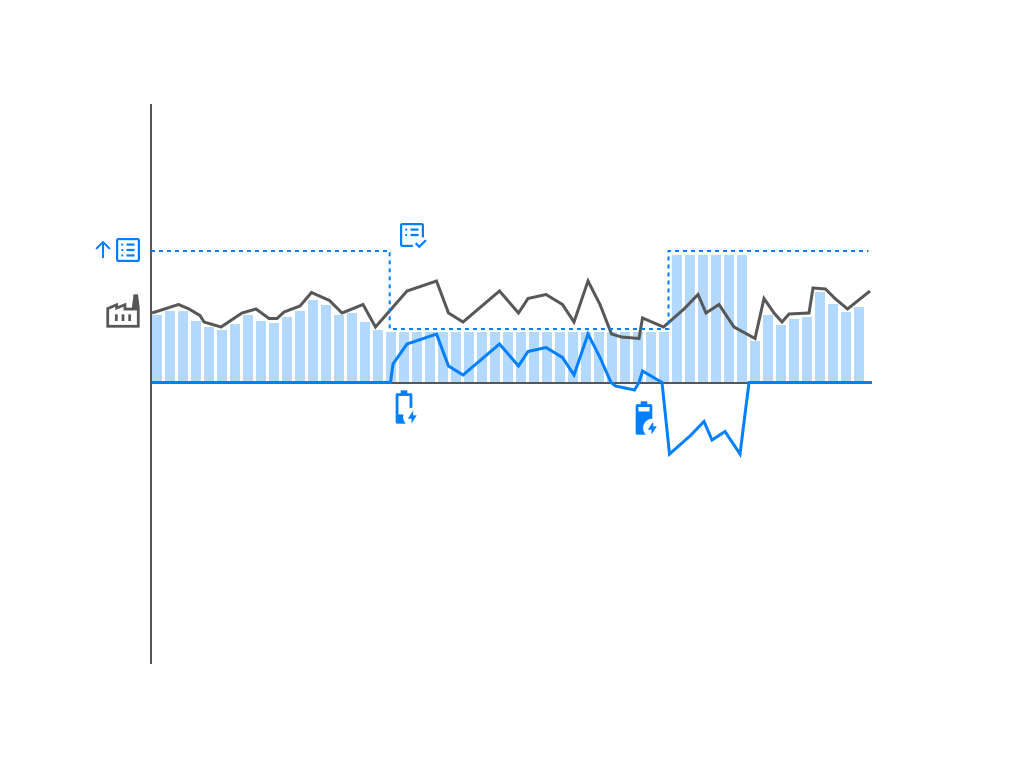
In practice, this functionality will also frequently occur in combination with other control strategies. In this second graph, the combination of the Grid Connection Guard incl. CBC with Storage Peak-shaving is shown. The transport capacity for grid consumption is halved during the day, but consumption continues, creating a shortfall. Because the contracted capacity changes, this change is seamlessly taken over by the peak-shaving functionality, which will step in to compensate for the shortfall. As soon as capacity becomes available again — for example due to an increase in the maximum transport capacity — the battery will recharge to prepare for the next peak.
If a dynamic energy contract is in place, it may optionally be combined with Storage Control day-ahead to further optimise the moment of charging.
Additional information
Flexible contract types are increasingly emerging, with the aim of alleviating the effects of grid congestion. Examples include a CBC contract with fixed time slots agreed upon to reduce transport capacity, typically during hours when supply and demand are significantly out of balance. Or conversely, in the form of block power whereby additional transport capacity is made available during off-peak hours so that a business can, for example, charge electric vehicles at night. Another form is when transport capacity is restricted on demand; this will always be in combination with a Congestion Service Provider (CSP). The text below explains in more detail how this regulation functions in combination with other systems and which technical and operational considerations apply.
Different control parties
The chosen control party (CSP) for external control can vary considerably. Each party uses its own trading algorithm. The Envi.Baseenvi.baseDe energiecontroller van Envitron die apparaten uitleest, aanstuurt en data opslaat achter de hoofdaansluiting. supports switching between parties without additional configuration costs. This keeps the installation flexibly deployable with different energy suppliers or market parties. Some of the parties that currently have an integration include:
- Repowered
- Edmij
- Eneco
- Groendus
- Greenchoice
- FridayEnergy
- EddyGrid
- PureEnergie
- Tibo Energy
Integration and validation
For the integration with the trader, the Envi.Baseenvi.baseDe energiecontroller van Envitron die apparaten uitleest, aanstuurt en data opslaat achter de hoofdaansluiting. uses a secured API connection. This integration is tested in advance according to established process agreements between Envitron and the connected trading platforms. After successful validation, the regulation is released for operational use via the service partner or the end customer.