Third-Party Storage Control with FCR Regulation
The FCR regulation, or control for the FCR market, is a complex functionality with important conditions, including a minimum capacity of 1 MW. The qualification process is a complex procedure that can take considerable time; the system must be tested and the results reported to TenneT. An energy supplier (BSP) often facilitates this process, with support from Envitron.
In brief
Making storage installations controllable for third parties in order to increase system yield based on external information or frequency.
The third-party storage control regulation including FCR is applied when a storage installation is present behind a connection and the (end) customer wishes to control this installation based on external information or to keep the grid frequency balanced (FCR). This regulation is often used when a customer has signed a contract with TenneT and therefore wants their storage system to be controlled by, for example, a BSP or CSP. The regulation, in combination with the Envi.Baseenvi.base De energiecontroller van Envitron die apparaten uitleest, aanstuurt en data opslaat achter de hoofdaansluiting. energy controller, facilitates control by the energy supplier.
BSP stands for Balance Service Provider and CSP for Congestion Service Provider. These are parties that are certified and approved for controlling imbalance services or capacity management, such as for a capacity limitation contract (CBC).
How it works
This regulation connects the energy supplier's trading algorithm (also known as the 'trader') with the storage system or battery on site. The Envi.Baseenvi.base De energiecontroller van Envitron die apparaten uitleest, aanstuurt en data opslaat achter de hoofdaansluiting. energy controller is physically connected to the battery; via an API connection, the trader can then control the installation as desired. The regulation monitors the correct processing of the control signals. The trader also has the additional option to activate FCR mode, which enables the battery to be deployed to keep the grid frequency balanced.
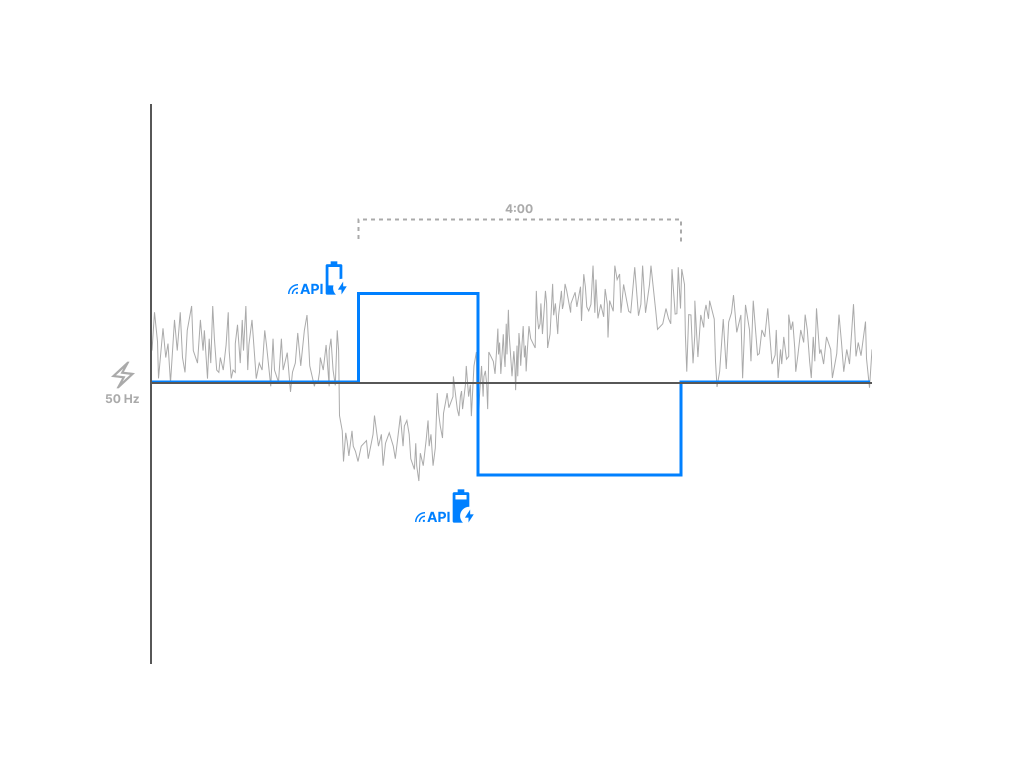
In the example above, a 4-hour time block is selected during which the battery is deployed for FCR. The trader activates this, and locally the Envi.Baseenvi.base De energiecontroller van Envitron die apparaten uitleest, aanstuurt en data opslaat achter de hoofdaansluiting. energy controller ensures that the charging and discharging of the battery is aligned with the grid frequency. At a frequency below 50 Hz the battery will discharge, and above 50 Hz it will charge, in order to keep the frequency balanced. The charging and discharging can switch very rapidly in short intervals.
Due to the speed and variable control associated with these FCR services, not every battery is suitable for this purpose. Always consult the battery supplier or manufacturer regarding the possibilities.
Additional information
The Third-Party Storage Control with FCR regulation makes it possible to control battery systems based on external market signals. The text below explains in more detail how this regulation functions in combination with other systems and what technical and operational considerations apply.
Different control parties
The chosen control party for external management (such as a BSP or CSP) can vary considerably. Each party uses its own (trading) algorithm. The Envi.Baseenvi.base De energiecontroller van Envitron die apparaten uitleest, aanstuurt en data opslaat achter de hoofdaansluiting. supports switching between parties without additional configuration costs. This keeps the installation flexibly deployable with different energy suppliers or market parties. Some of the parties that currently already have an integration include:
- Repowered
- Edmij
- Eneco
- Groendus
- Greenchoice
- FridayEnergy
- EddyGrid
- PureEnergie
- Tibo Energy
Integration and validation
For the connection with the trader, the Envi.Baseenvi.base De energiecontroller van Envitron die apparaten uitleest, aanstuurt en data opslaat achter de hoofdaansluiting. uses a secured API connection. This integration is tested in advance according to established process agreements between Envitron and the connected trading platforms. After successful validation, the regulation is released for operational use via the service partner or the end customer.