Storage Control Day-Ahead
In brief
"Switching storage systems based on (negative) day-ahead hourly prices to reduce the cost of electricity consumption and increase the revenue from electricity feed-in"
The storage control day-ahead strategy is applied when a storage system and a day-ahead hourly price energy contract are present on the same connection. This combination offers an opportunity to consume electricity during cheap or sometimes negative hourly prices and to supply electricity during expensive hours. The storage control day-ahead strategy activates a storage system during cheap hours to fully charge it with inexpensive electricity. During expensive hours, the strategy activates the storage system to supply electricity to consumers.
How it works
This strategy continuously monitors the hourly price of the day-ahead market through a software integration and automatically controls the storage installation based on the most favourable prices. The number of hours can be specified, as well as the maximum power at which charging/discharging should occur and the margin between the cheapest and most expensive hours. The strategy then selects, for example, the two cheapest hours for charging and the two most expensive hours for discharging, provided the difference between these two is at least 0.12 EUR per kWh.
The difference between the highest and lowest price of the day must be a certain amount apart before this is truly worthwhile. This spread can be adjusted.
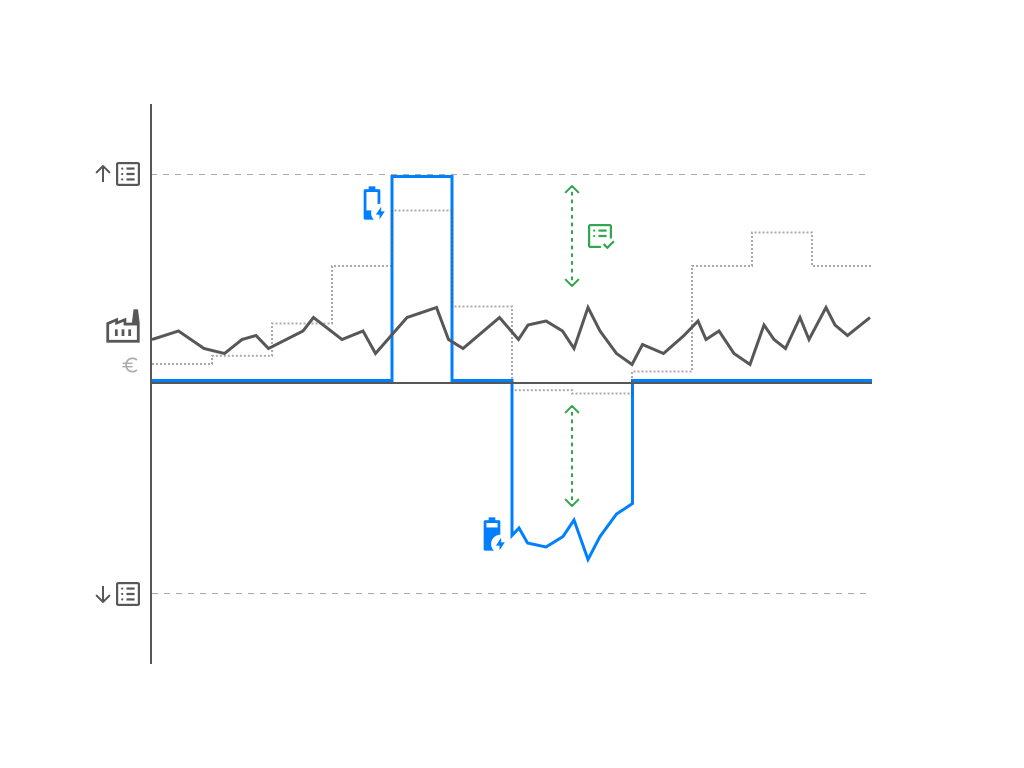
In the graph above, it can be seen that the battery receives a signal earlier in the day to discharge at maximum capacity, because prices are high at that moment. Later in the afternoon, prices are at their lowest, or even negative, and the battery receives a signal for several hours to charge again. Because the grid connection has a limited capacity, this is continuously adjusted in combination with the Grid Guard to maximise charging.
Flexibility
With this strategy, it is also possible to charge or discharge the battery independently based on day-ahead prices. This often occurs in combination with another strategy, such as self-consumption optimisation. With the day-ahead control, it is possible to set an offset that is added to the base EPEX Spot price to account for VAT, fixed surcharges from the energy supplier, and energy tax.
Additional information
The Storage Control Day-Ahead strategy optimises the charging and discharging of energy storage based on hourly prices from the day-ahead market. The following sections explain in more detail how this strategy can be applied in specific situations and which parameters influence the result.
Spread and margin between prices
The difference between the highest and lowest hourly price, the so-called spread, largely determines the return on the storage strategy. When this difference is too small, it is not financially worthwhile to charge or discharge. The minimum spread can be set manually, for example 0.12 €/kWh. The strategy then automatically selects the cheapest hours for charging and the most expensive hours for discharging, provided the configured difference is achieved.
Combination with other strategies
This strategy can be combined with other strategies, such as Self-Consumption Optimisation or the Grid Guard. In these configurations, Envi.Baseenvi.baseDe energiecontroller van Envitron die apparaten uitleest, aanstuurt en data opslaat achter de hoofdaansluiting. coordinates between the different strategies to prevent overloading of the connection and to make optimal use of storage capacity. When used in combination with generation control (such as solar panels), the battery can also be deployed to compensate for feed-in during negative prices.
Technical considerations
When applying storage control, it is important that the parameters for charge power, discharge power, and margins are carefully configured. Too high a load can lead to unnecessary battery wear or limitation due to grid connection capacity. In addition, the communication between the storage installation and Envi.Baseenvi.baseDe energiecontroller van Envitron die apparaten uitleest, aanstuurt en data opslaat achter de hoofdaansluiting. must be reliable, so that price changes on the day-ahead market can be processed in a timely manner.